




While most luxury eyewear brands treat their creations as mere “fashion accessories,” DITA operates in a realm of its own—approaching frame-making through the precise logic of micro-engineering, the rigorous mastery of Japanese craftsmanship, and an extraordinary investment of time and dedication. It is an unyielding commitment to structure, material, and detail that commands pure reverence, elevating the brand to a stature uniquely its own.
Recently, DITA has been actively expanding its Asian footprint, embarking on a tour across major regional hubs. Upon their arrival in Hong Kong, V.MAGAZINE had the exclusive opportunity to sit down with the brand’s core leadership—CEO Micky Dhillon, Design Director Michael Castillo, and COO Cody Cho. Through this in-depth conversation, we immerse ourselves in the brand’s core across multiple dimensions—spanning DITA’s direct strategy, the engineering aesthetics embedded in their design details, to their long-term vision for defining high-end eyewear.
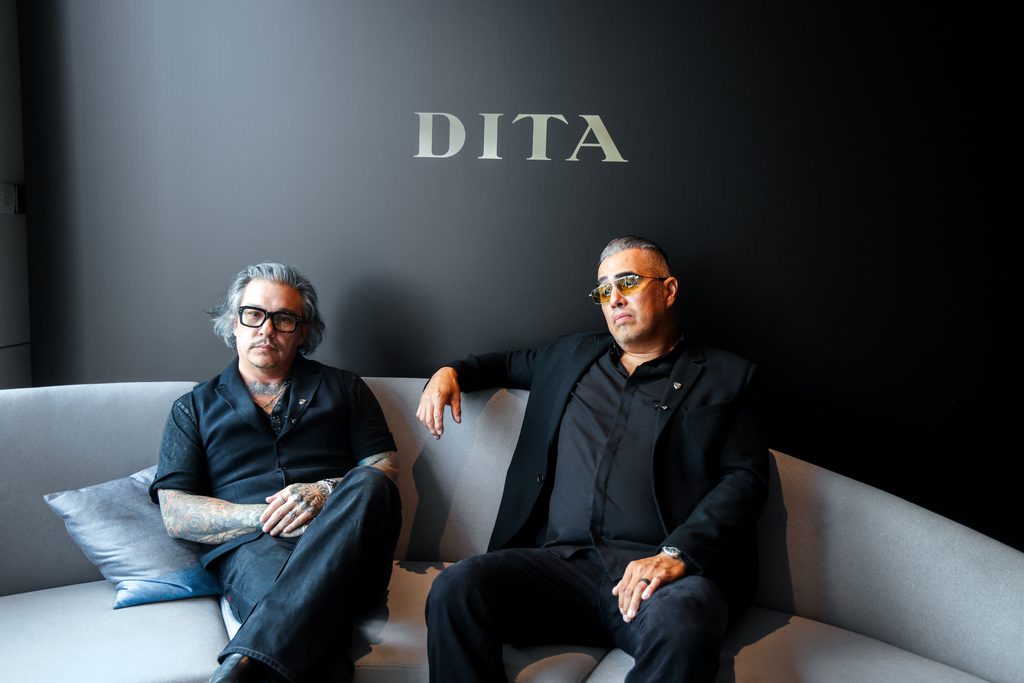
▲ Cody Cho, Chief Operating Officer (left), Michael Castillo, Design Director (right)
V.MAGAZINE: Mr. Dhillon, since DITA’s founding in 1995, you have been involved with the company as one of its initial investors. What has driven your unwavering dedication to this brand throughout the years?
Micky Dhillon: It’s interesting. I met these two young men 30 years ago. They were doing my Christmas lights on my house. And I’ve always had a big brother program where I would help other young men, but we’re about the same age, only a three- or four-year difference. They had some ideas and I said, “you can always come back and talk to me”. And I gave them quite a bit of money to help them build a brand. I always stayed involved just to support them. But 2011 was when I decided to take it over because they were having financial problems. So that’s why I’m always committed.
I’d say DITA has the best people in the world. People make companies. Owners don’t. And I try to stay involved in every interview, even from retail to warehouse, to give one opinion. Great people make great companies. We have amazing people in our team worldwide.
V.MAGAZINE: Over the past year, as DITA shifted from a distribution model to direct operation, what operational and strategic actions have been taken for this reactivation?
Micky Dhillon: DITA is direct worldwide. The first thing I did in a humble way when I studied what my distributor did, I shut down 60% of what I thought in a humble way. No disrespect. And some of them I will open back up. When you build companies, you have to do it very slow and steady. Fast growth is not the bottom line to me.
We will see the response from clients, make sure customer service and in-store experience are right, and create the right product just for this territory. You can’t just make the best frames in the world without the best service and support. Every detail will be important and also how you make the brand come across.
Cody Cho: It’s very important to start from the wholesale perspective. We’re reinvesting in our wholesale partner to really help sell the brand, because we don’t have direct flagship here. That investment comes with better logistics, better planning in inventory. When we talk about that Pacific Modern Collection, which is geared specifically for Asian consumer, it’s investing in raw materials, inventory, planning to have them have the proper products so they can sell to the proper market.
Because what works here in Hong Kong is different from the U.S. and different from Europe. That’s why from a design perspective, we need to design collections that fit this market, this demographic. And I think we’re one of the only companies that creates a collection designed specifically for the Asian market where everybody else, they’ll just take the frame and adjust the nose pad.
We design with more comfort in mind – lightweight, better fit for temples, better fit for the face. And all that requires manufacturing, tooling, cost. It’s very expensive. But for us, we see that investment is worth it for the long term. We’re here to really grow this market and not take shortcuts. So do it slow, but do it right.
V.MAGAZINE: How are you picking the right retail partners in Asia? And what are you going to do to make sure it’s a win-win in the long run?
Cody Cho: I think that’s the most important thing right now as DITA goes direct. We’ve worked with other partners in the past, we’ve actually closed lots of doors that didn’t align with our philosophies. What we’re trying to do is to take this opportunity to really slow down, take a breath, and only work with the best retail partners that can really invest in brand knowledge, training, be able to communicate the DITA DNA of who we are. It’s a very time-consuming process, but it’s very important.
10 good retail partners can take your company up in sales. One bad retail partner can hurt your brand substantially through not representing the brand well. It can hurt the brand worse. Everything that we’re doing right now is making sure that every partner that we invest in is in the same alignment with our vision to grow in this market. No shortcut.
And that requires us to invest in them through marketing, through supply chain, through product development. So that they can sell and make more money. For us, we’re trying to make sure that they are successful. Because if the retail partner is successful, then we will be successful too.
V.MAGAZINE: How do you promote DITA from a marketing perspective?
Cody Cho: We understand that with the Asian market, it’s very influencer-focused. It’s very celebrity-focused. So we’re making large investments when it comes to talent, collaboration, partnership with the right celebrity and influencers. Because we understand that the consumer sees what people are wearing. They want to wear that frame.
In the United States, celebrities wear our frames. We’ve been very blessed to have those relationships. Now I’m being educated on who the cool people are. And that’s where we’re focusing right now.
V.MAGAZINE: Michael, you’ve designed some of DITA’s most iconic frames—like the Grandmaster, Mach, Flight, and Statesman—some of which have stayed relevant for over 20 years. In your view, what does it take to build a true brand classic? And looking at the FW26 collection, which style do you think has the potential to become the next icon?
Michael Castillo: That’s a difficult one because even when we designed some of those icons that you mentioned, we didn’t know they were going to be icons, right? You don’t know how your designs or your products are going to be perceived and accepted by the consumer, right? So it’s almost impossible.
If you knew that formula, then you would be a billionaire because you would be making nothing but iconic brands or designs, right? It’s really hard. We go into design truly believing that everything’s going to be an icon, right?
But if we really wanted to hit that one single point, it would be an updated design with any of those names because our biggest fans, the ones that are really cult following that they really do anything to buy the next DITA, if they see any one of those names attached to a new design, they’ll buy it. That’s how obsessed they are with DITA. And as far as all the new stuff coming out, it’s like I said, we all go into thinking that they’re all going to be icons.
In the FW26 collection, I think the LINEAGE series will be the best seller because it shows the complexity of what people expect from DITA and it really showcases our manufacturers and the tolerances and the surfacing.
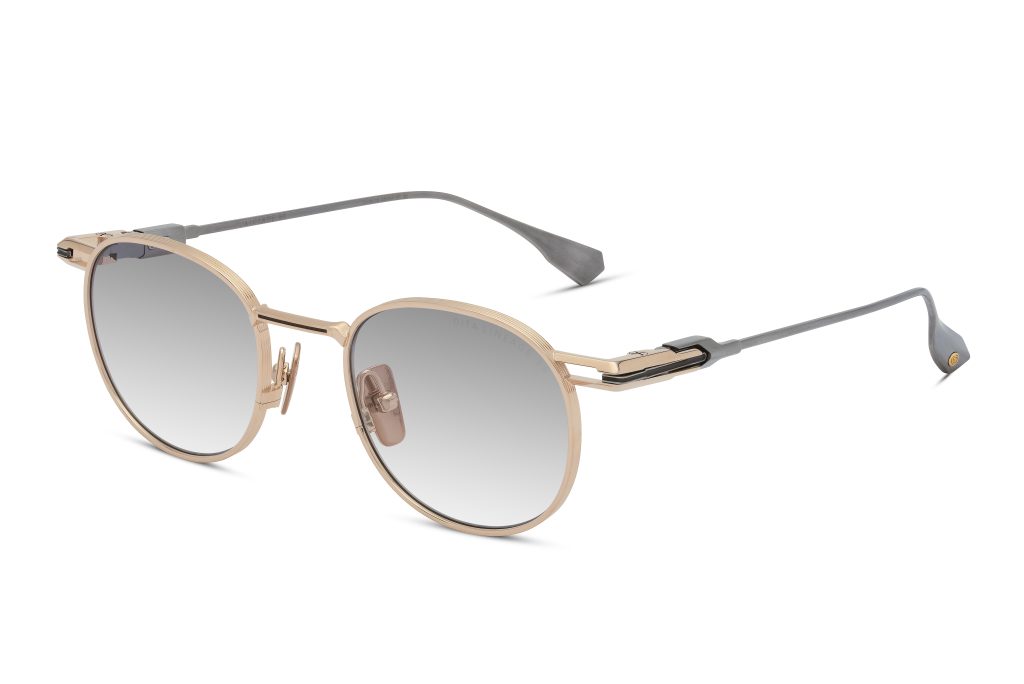
▲ LINEAGE-68
V.MAGAZINE: In your eyes, what truly defines the real value of a DITA frame?
Michael Castillo: We do a great job of educating our consumers to let them know the process of that craftsmanship. Because to me, DITA’s value in the product is not because something is gold plated or has a super complex construction.
It’s the process. Because the process is so long when designing and manufacturing a DITA frame. It takes so much time. And the one thing in this world we can’t buy is time. And if you use a lot of it, that means you’re spending a lot of money.
V.MAGAZINE: Looking at your recent work, what is the most challenging design that you have to push your artisan in Japan to bring to life?
Michael Castillo: There’s a frame over there called the HYPERLUX. That frame is a culmination of complexity and design when it comes to DITA and DITA World – from the way the temple folds into the end piece to how the centerpiece has to be structured. The manufacturing tolerances are extremely tight. If you hold it up to the light, and even a single horizontal layer on the temple was off by half a millimeter, you would notice it. And that’s just one of about 40 to 50 individual pieces that make up the frame. Every single detail has to be absolute precision. I know things in life are not perfect, but we always strive for perfection when it comes to DITA. Because we are designing frames like that which have multiple horizontal layers on top of each other. If just one horizon is slightly off, it ruins everything else.
Frames like this are going to do really well in Hong Kong and Mainland China.
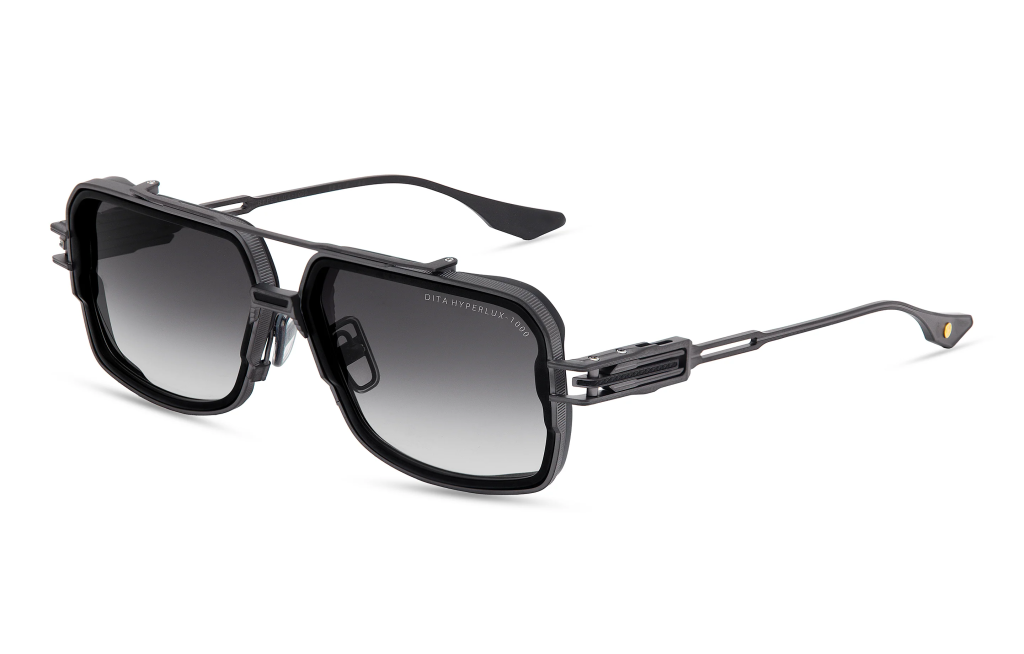
▲ HYPERLUX-1000
V.MAGAZINE: We’re seeing more premium eyewear labels entering the space—many of which share a common thread: being made in Japan. What’s your take on this landscape? And how does DITA distinguish itself from other players in the market?
Cody Cho: We don’t really look too much at other brands as competition. I can put it simply. You could book a flight to Sabae, take the glasses, and say, “Make this for me”. Bring them money and they’ll make you that frame. And you have your own brand. But you’re not a designer. What did you do to evolve? Or what did you do to innovate? To make difference? Maybe make the shape a little bit bigger or smaller.
That is what the eyewear world is doing. When you look at other premium brands, just because it’s made in Japan does not mean luxury. When these brands say, “Oh, this takes many steps, 350 steps, nine months to make” – time does not define luxury. Time is a byproduct of the manufacturing process. But what did that time do? Did it create innovation? Did it push the boundaries of engineering? Did it make something new feature-wise to help make the frame better or fit more comfortably? That’s where I see that trend going.
For us, our team has 100 years of combined experience designing and doing engineering at a level where we push our factories. Sometimes we take this frame, we say, “Factory, make this frame.” They might say it’s too complicated. But we push. Because if we can expand factory capabilities, then everybody in the industry grows and maybe make better products at the end of the day, not just boring products. So for us, that is the future of what we are seeing ourselves.
Any business that anybody does should try and do something better, not copy. For us, we take it as flattery. But when it comes to these other brands, I can put my frame on a wall of other frames, and I can show you every detail of that frame, of why that stands apart, and why this is a more unique product.
“Made in Japan”, the craftsmanship is great. But true product innovation comes from the brand. And I don’t think there’s anybody that does that better than us.
Big Mike has 30 years design experience, designing luxury. Some of these brands, I don’t know who their designers are. What’s their resume? Big Mike has designed the Mach series, Statesman series, Flight series, and Grandmaster series, all the best-selling DITA franchises. He mentors his design team. He has junior designers under him. He has engineers that he works with. And that’s why we’re here, to show you who this person is. I don’t know who other people’s designers are. Do they have them? Maybe they don’t.
V.MAGAZINE: Experiential retail is a major focus right now. Beyond traditional marketing, how is DITA elevating the retail experience for consumers?
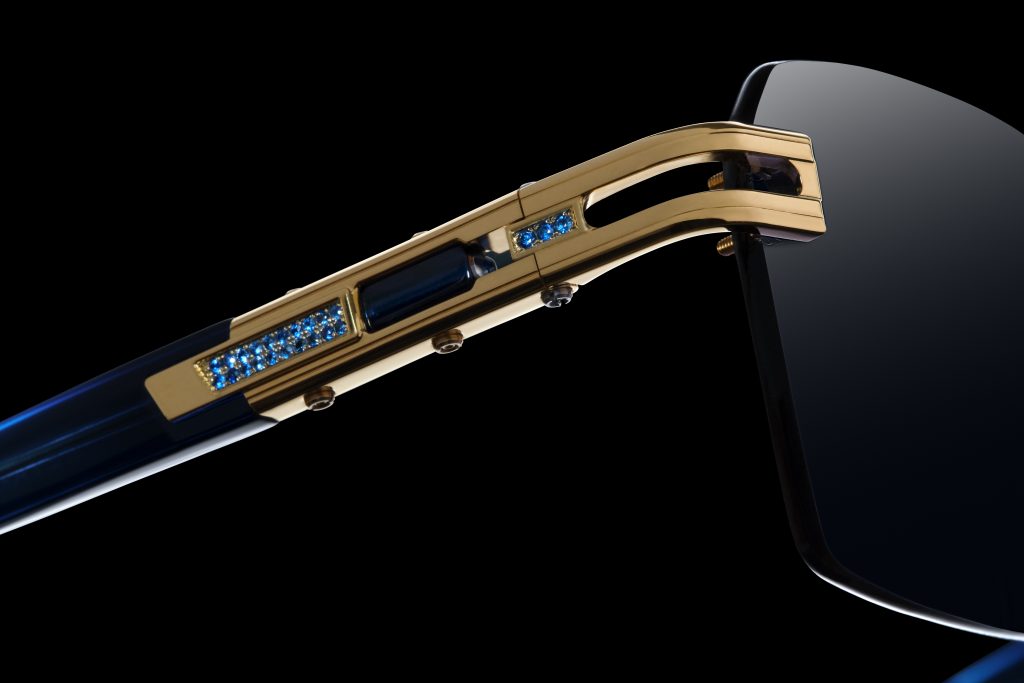
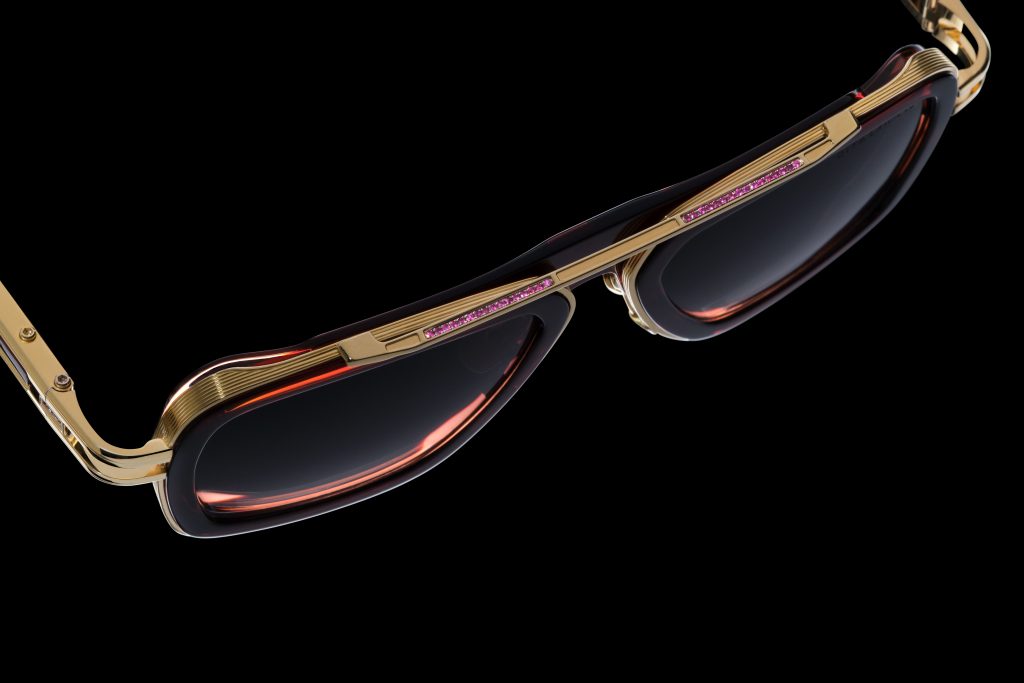
Cody Cho: At times, I actually consider DITA a technology company, not just an eyewear brand. When you look at the INOVATI line, we developed an iPad application allowing clients to design a bespoke frame—we’re even the first company capable of setting diamonds into titanium. It’s designed with extreme intention so that it never looks tacky. True luxury is always about subtle detail.
We’re bringing that same experiential customization to iconic styles like the Flight.006. Through the app, clients in our stores can customize the frame color, orbitals, lenses, and gemstones, creating over 500 combinations. Truly unique.
We’re only going to expand upon that. The next phase will be coming out next year. We have things coming out over the next few years of fully customization. It will take things to a whole other level, the likes that this industry has never seen before. One day, you can walk into a store and we can build you a frame using DITA components and existing styles to make a completely unique one-of-one frame for you. That’s kind of the beauty of being owned by a single family. If we have crazy ideas, we don’t have to go through a board. We don’t have to go through approvals. We just do it.
//
As our conversation comes to a close, looking closely at the crisp, uncompromising lines of the HYPERLUX feels like witnessing the distilled essence of DITA’s soul. Driven by an unshakeable reverence for craftsmanship and a fiercely independent spirit, DITA moves steadily at its own rhythm—carving out a legendary trajectory uniquely its own across Asia and the global eyewear landscape.